
What is Fault Current?
Fault Current is the electrical current that flows through a unintended path after insulation fails, conductors touch, or a connection reaches ground. Its size depends on source voltage and circuit impedance. Protective devices use this current to detect dangerous conditions and disconnect power before conductors, equipment, or buildings suffer severe damage.
Quick Facts About Fault Current
Category
Electrical safety and system protection
Formula
Approximate current equals voltage divided by impedance
Measured by
Amperes, often estimated through a fault-current study
Used for
Sizing breakers, fuses, busbars, and electrical equipment
Common confusion
Fault current is not the same as normal operating current.
Also called
Short-Circuit Current, Available Fault Current
Key Takeaways About Fault Current
- Fault current follows a unintended path from a short circuit, ground fault, or equipment failure.
- Higher available fault current increases the energy released during a fault.
- Circuit breakers and fuses need suitable interrupting ratings for the available current.
- Engineers use system impedance, voltage, and equipment data to estimate fault current.
- A fault-current study checks protection, equipment ratings, and electrical safety.
Understanding Fault Current

Fault current is abnormal current that flows when electricity finds a unintended path. A short circuit may connect two energized conductors. A ground fault may connect an energized conductor to grounded metal or earth. Damaged insulation, loose wiring, water intrusion, and failed equipment can create these paths.
Related glossary terms: Short Circuit, Ground-Fault Circuit Interrupter, Overcurrent Protection.
Normal current travels through a planned circuit and supplies a load. A load may be a light or motor. Fault current can rise far above the circuit's expected operating current. Its actual value depends.system impedance. The source transformer, service conductors, branch-circuit wiring, connections, and fault path limit the current.
How Fault Current Works, Is Measured, or Is Used?
The basic relationship follows Ohm's law. Approximate fault current equals system voltage divided by total impedance. It's written as I = V/Z. A 120-volt circuit with 0.12 ohms of total impedance could produce about 1,000 amperes. This could happen during a low-impedance fault. The circuit may normally draw only 15 amperes.
Electrical professionals estimate available fault current at service equipment and panelboards. They also check motor control equipment and downstream circuits. They review the utility source, transformer data, conductor length and size, and equipment connections. The result helps determine the required interrupting rating of a circuit breaker or fuse. It also helps determine the short-circuit current rating of connected equipment.
Protective devices respond to fault conditions in different ways. A fuse melts when current and time reach its operating range. A circuit breaker opens its contacts through thermal and magnetic or electronic action.ground-fault circuit interrupter compares current leaving and returning through a circuit. It trips when the difference indicates leakage. This often happens before a conventional overcurrent device responds.
Why Fault Current Matters?
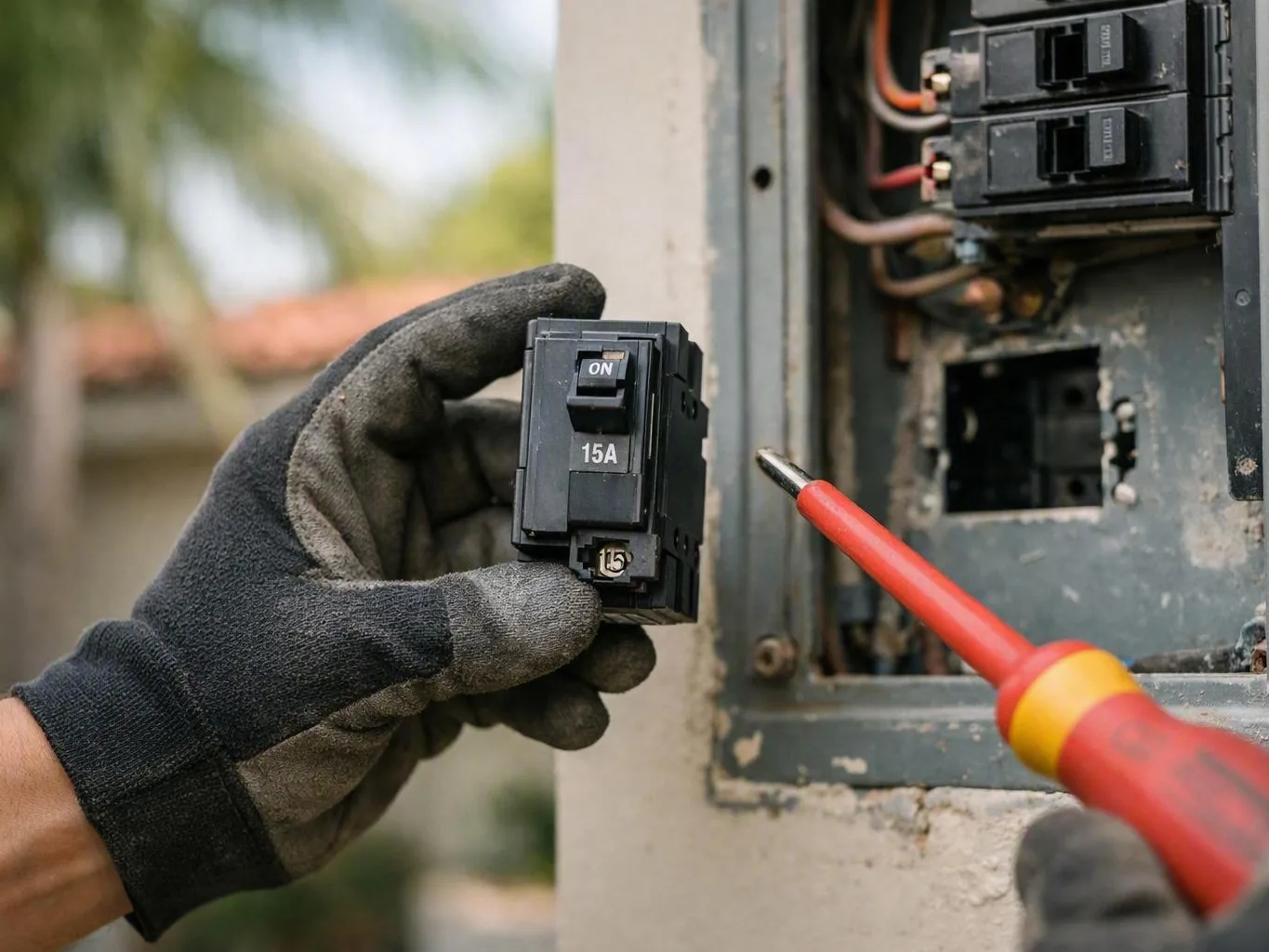
Fault current creates heat, magnetic force, sparks, and arc energy. The damage can affect conductors, insulation, busbars, enclosures, and nearby equipment. A breaker that can't safely interrupt the available current may fail to clear the fault. This failure can increase equipment damage and fire risk.
Correct fault-current information supports equipment selection and protection coordination. A panelboard or breaker must have an adequate short-circuit current rating. It must also have enough interrupting capacity for its location. Labels, calculations, and field conditions should agree. This matters after a service upgrade, transformer change, generator installation, or major rewiring project.
When Fault Current Matters Most?
Fault current becomes a key concern during new construction and service changes. It also matters during panel replacements and large motor or generator installations. A new transformer or shorter service connection can increase available current at a panel. A long feeder or undersized connection can reduce fault current. This may affect whether a breaker trips quickly enough.
Evaluation also matters after repeated breaker trips, burning odors, visible arcing, water damage, or unexplained equipment failure. Technicians inspect for damaged insulation, loose terminations, incorrect breaker ratings, and missing bonding paths. Work on energized equipment carries serious risk. Testing and verification require suitable instruments, procedures, and personal protective equipment.
How to Evaluate Fault Current?
- Compare the available fault current with each breaker or fuse interrupting rating.
- Check the equipment label for a short-circuit current rating that suits the installation.
- Review transformer size, service impedance, conductor length, and conductor size.
- Look for current study documents after service, generator, transformer, or major panel changes.
- Inspect for loose connections, damaged insulation, corrosion, heat marks, or repeated trips.
Related Concepts Compared
Fault Current vs. Short Circuit
A short circuit is one type of fault that creates a low-resistance path between conductors. Fault current is the resulting current, regardless of the specific fault type.
Fault Current vs. Ground Fault
A ground fault occurs when current reaches grounded equipment, earth, or another grounded path. Fault current also includes line-to-line and three-phase faults.
Fault Current vs. Overcurrent
Overcurrent means current above a circuit's rated amount. Fault current is a severe form of overcurrent caused by a unintended electrical path.
Fault Current vs. Available Fault Current
Available fault current is the maximum current that the electrical source can deliver at a specific point during a fault. Actual fault current may be lower because of circuit impedance.
Expert Note
A high fault-current value is not the only concern. A low value can also matter if a breaker lacks enough current to trip quickly under its instantaneous or magnetic setting. Both high and low results deserve review against the protection design.
Common Mistakes or Myths About Fault Current
- Assuming the normal circuit load equals the available fault current.
- Installing a breaker with an interrupting rating below the available fault current.
- Treating a ground fault and a short circuit as identical conditions.
- Ignoring fault-current changes after installing a generator or upgrading service equipment.
- Relying on an old calculation after changing transformers, feeders, or panelboards.
Fault Current in Practice: A Real-World Example
A 120-volt branch circuit normally supplies 8 amperes to a lighting load. A hot wire may touch the box and send hundreds of amperes through the fault. The breaker trips when the path and breaker work correctly.
Sources & Further Reading on Fault Current
Related Services
Related Terms
Short Circuit
Short Circuit is a unintended low-resistance path that lets electric current bypass part of a circuit…
Ground-Fault Circuit Interrupter
Ground-Fault Circuit Interrupter is a protective device that monitors current flowing through an electrical circuit and…
Overcurrent Protection
Overcurrent Protection is a safety method that limits electrical current when a circuit carries more electricity…
National Electrical Code
National Electrical Code is a set of electrical safety rules published by the National Fire Protection…
Earth Electric
Have Questions About Fault Current?
Contact Earth Electric for practical guidance on Fault Current and related 24 hour electrician work in Miami.