
What is Short Circuit?
Short Circuit is an unintended low-resistance path that lets electric current bypass part of a circuit. The path may form between energized conductors, or between an energized conductor and ground. The resulting current can rise sharply, heat wires, damage equipment, trip a circuit breaker, or create fire and shock hazards.
Quick Facts About Short Circuit
Category
Electrical fault
Measured by
Fault current in amperes
Used for
Fault diagnosis and protection planning
Common confusion
Overload
Also called
Electrical short, Shorted circuit
Often discussed with
Electrical Troubleshooting, Circuit Breaker Repair
Key Takeaways About Short Circuit
- A short circuit makes an unwanted path with far less resistance than the normal circuit.
- Excess current can heat wires, harm equipment, and start an electrical fire.
- Breakers and fuses should stop short-circuit current before wires become too hot.
- Common causes include damaged insulation, loose connections, water intrusion, and faulty equipment.
- Do not reset a tripped breaker again until you find and fix the fault.
Understanding Short Circuit
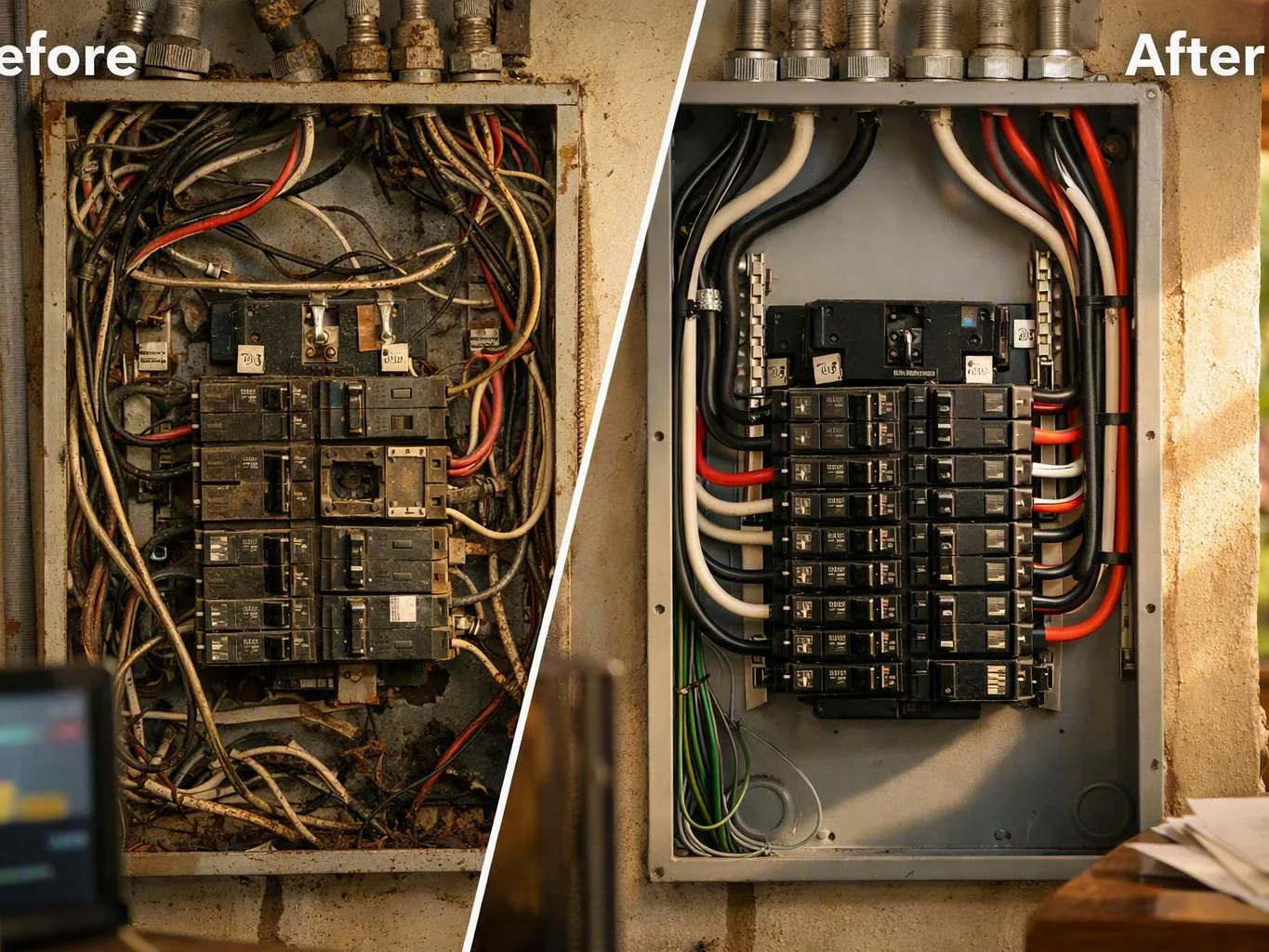
Short Circuit describes an unintended connection that creates a low-resistance route for electric current. Electricity normally travels through a planned route, such as a wire, load, and return conductor. A short circuit bypasses some or all of the load, so current can rise far above normal circuit levels.
Related glossary terms: Fault Current, Overcurrent Protection, Ground-Fault Circuit Interrupter.
The fault may occur between two energized conductors. It may occur between an energized conductor.neutral wire. It may also occur between an energized conductor and ground. Damaged insulation, loose wire strands, metal debris, water, and failed components can create the connection. The sudden current may produce heat, sparks, smoke, equipment damage, or a tripped circuit breaker.
How Short Circuit Works, Is Measured, or Is Used?
A circuit follows the relationship described by Ohm's law. It's written as I = V/R. Here, I is current, V is voltage, and R is resistance. If resistance drops sharply while voltage remains present, current rises sharply. For example, a 120-volt circuit has a 0.1-ohm fault path. This path would create a theoretical fault current of 1,200 amperes. Wiring and utility equipment limit the actual value.
Electricians locate a suspected fault by checking the affected circuit. They disconnect loads, inspect conductors, and test for unwanted continuity or insulation failure.multimeter can help with de-energized checks. An insulation resistance tester can reveal weakened insulation. A qualified technician also considers the available fault current, conductor ampacity, breaker rating, and equipment short-circuit current rating. The technician checks these items before restoring power.
Why Short Circuit Matters?

Short-circuit current can damage a conductor in a fraction of a second. Protective devices include fuses and overcurrent protection. They must interrupt the current before wires or equipment reach dangerous temperatures. If the protective device doesn't operate correctly, the fault can cause arcing, fire, or severe equipment damage.
A tripped breaker often provides useful evidence. But it doesn't identify the exact cause. Repeated resets can extend damage or expose people to an energized fault. The safest response is to leave the breaker off, keep away from smoke or heat, and have the circuit inspected before use.
When Short Circuit Matters Most?
Short circuits deserve prompt attention after an outlet sparks. They also need attention when a breaker trips immediately. Act quickly when a light flickers after water exposure. Get help when a burning odor comes from a panel or device. Older wiring, damaged cords, crowded boxes, and outdoor equipment increase the chance of insulation damage. Moisture is a particular concern in kitchens, bathrooms, garages, pools, and storm-affected areas.
The condition also matters during remodeling, panel work, generator installation, and new circuit installation. A technician must verify conductor connections, grounding paths, breaker compatibility, and enclosure condition. The technician must do this before energizing the system. In Miami, heavy rain, flooding, or humid conditions can cause water intrusion. This makes outdoor and service equipment inspections especially important.
How to Evaluate Short Circuit?
- Does the breaker trip immediately when the circuit is energized, or only after connected equipment runs?
- Are there scorch marks, melted insulation, loose terminals, buzzing, smoke, or a burning odor?
- Does the circuit have the correct breaker rating for the conductor size and equipment?
- Was the circuit exposed to water, recent construction work, pests, or a damaged cord?
- Has the fault been tested and corrected, rather than hidden by repeated breaker resets?
Related Concepts Compared
Short Circuit vs. Overload
An overload draws too much current through the intended circuit path, often because too many loads are connected. A short circuit creates an unintended low-resistance path and usually produces a much faster current surge.
Short Circuit vs. Ground Fault
A ground fault is a current path from an energized conductor to ground or grounded equipment. It is a type of fault that may overlap with a short circuit, but the terms are not identical.
Short Circuit vs. Open Circuit
An open circuit has a broken path, so current stops or becomes very small. A short circuit has an unintended path with very low resistance, so current can become dangerously high.
Short Circuit vs. Arc Fault
An arc fault involves electricity jumping across a gap or damaged connection. A short circuit may create an arc, but an arc fault can also occur without a solid metal-to-metal short.
Expert Note
A breaker trip identifies abnormal current, not the failed part. The fault may be inside a receptacle, cable, appliance, junction box, or panel connection. Testing should begin with a de-energized circuit and continue until the cause is isolated.
Common Mistakes or Myths About Short Circuit
- Treating every breaker trip as a defective breaker.
- Resetting the breaker repeatedly without finding the cause.
- Confusing a short circuit with an overload.
- Testing energized wiring with tools or methods not rated for the circuit.
- Ignoring moisture, heat, buzzing, or burning odors after a fault.
Short Circuit in Practice: A Real-World Example
A bathroom receptacle trips its breaker whenever someone plugs in a hair dryer. Inspection finds moisture and a damaged terminal inside the box, joining live wire to ground. Replacing the device and fixing moisture clears the fault.
Sources & Further Reading on Short Circuit
Related Services
Related Terms
Fault Current
Fault Current is the electrical current that flows through an unintended path after insulation fails, conductors…
Overcurrent Protection
Overcurrent Protection is a safety method that limits electrical current when a circuit carries more electricity…
Ground-Fault Circuit Interrupter
Ground-Fault Circuit Interrupter is a protective device that monitors current flowing through an electrical circuit and…
Open Circuit
Open Circuit is an electrical path with a break that stops current from flowing through the…
Earth Electric
Have Questions About Short Circuit?
Contact Earth Electric for practical guidance on Short Circuit and related 24 hour electrician work in Miami.